 Phoenix Court
The Three Clock Speeds
Written by Phoenix Court
19 Oct 2026 — editorial
 How do you remain focused amid deafening noise?
It’s a question founders ask themselves on a daily basis, as they navigate their way through innumerable distractions to make decisions that may prove invaluable. And it’s a question that investors frequently ask themselves too, in the search for companies building genuine and enduring value in a noisy market.
As an investor, one of the most disciplined things you can do is ignore what the rest of the market is doing and pursue where you see real opportunity and differentiation. This transcends short term investment returns, and is far more focused on the long term benefits of pursuing multi-decade, multi-generational waves of innovation.
This all comes down to our central belief that great ideas and great businesses don’t all move at the same speed, but rather across three clock speeds, a theme that ran across our 2026 Annual Showcase.
The fast clock refers to the AI-powered giants that emerge overnight, those that launch new capabilities and define categories in weeks and months, not years. This may yield short-term success, where valuation multiples and exits appear in time frames previously thought impossible, but is also the noisiest category.
The stable clock refers to the solid, revenue-generating business that might not capture headlines everyday, but will continue to compound in value over years. Our Colts ($25M+ revenue) and Thoroughbreds ($100M+) will continue to bring in real money even when markets contract and valuations vanish.
And then there are the long clock businesses, science and frontier tech businesses that may take decades to build, but will come to define future generations. Possibility is slow and remote until one day, it isn’t.
Our 2026 Annual Showcase took place at Heatherwick Studio’s Making House, in King’s Cross at the heart of New Palo Alto. This showcase is a chance to show the depth and breadth of the companies we’ve had the fortune to work with: and how better to showcase this than demonstrate their strengths in building across all three clock speeds. At the fast end, microagi; at the stable middle, Tide; and at the long clock, Early, Robeauté, and BioOrbit. Each company shared the unique opportunities and challenges of building at all three stages.
The stable clock
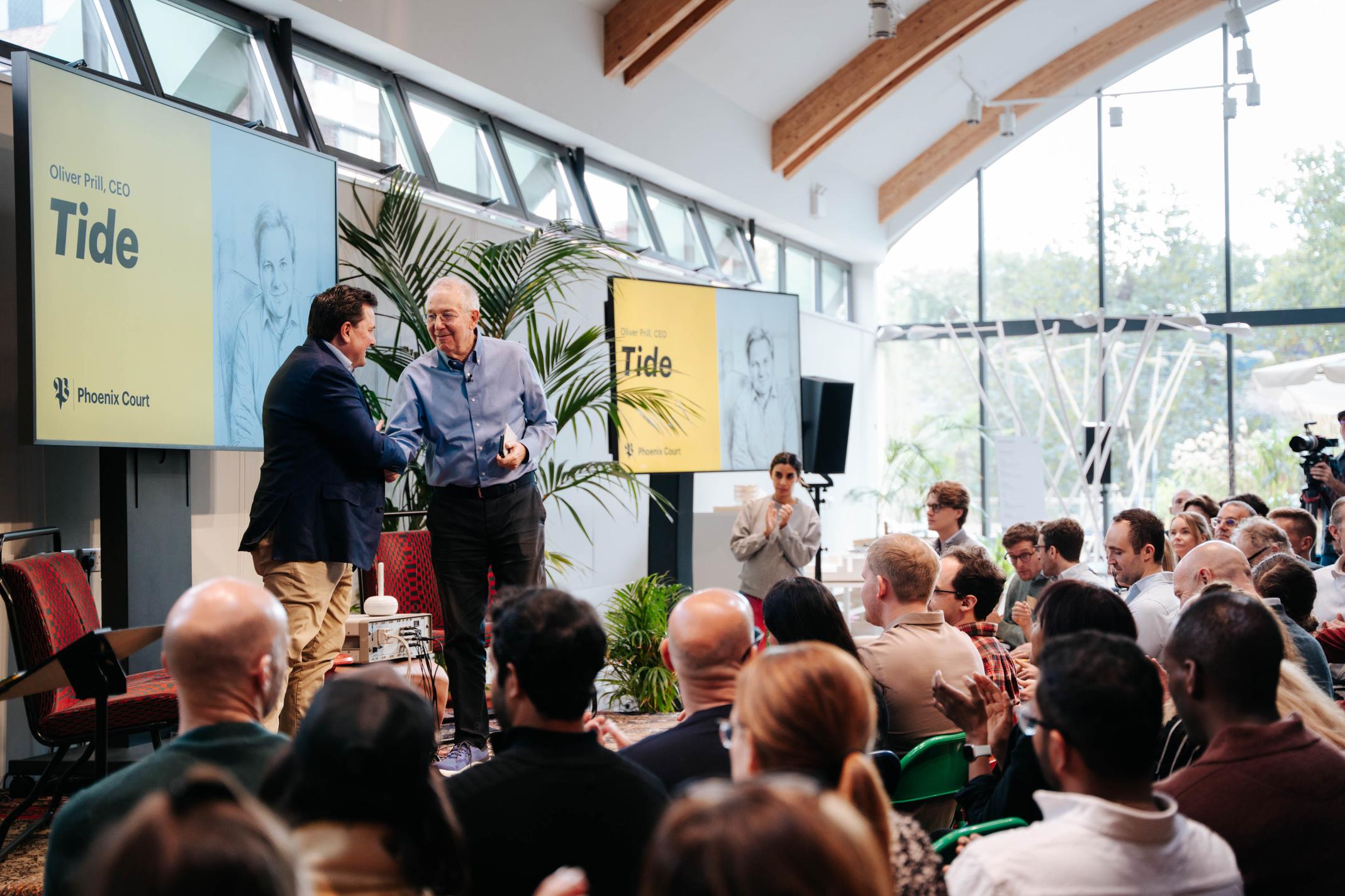 How can a near-$500M revenue business still be considered early?
That’s a question that was put to Tide’s CEO Oliver Prill, who joined Robin Klein on stage at the Showcase. Tide is exemplary of the stable clock category: a business we backed over 10 years ago and which has steadily compounded into one of the UK’s most durable fintech businesses. Their success lay in capturing a key inflection point, when the digitisation of consumer banking prompted demand from business owners for a similar unified, digital platform.
It’s important to remember that fintech was once the hot category, before experiencing its own correction. Tide’s own exposure to the fast clock has undoubtedly shaped their outlook today, seeing pressure shift from growth to profitability. They’ve done this by remaining relentlessly focused on their customers, building enviable loyalty in the process.
That’s not to say that Tide isn’t impacted by AI; on the contrary, their success has been in their strategic adoption of the technology. Oliver shared three key dimensions for how they think about AI.
From a software perspective, what can they build internally, and can they build it fast enough to see off competition from AI-first competitors? From an operational perspective, how can they transform internal operations and critical services like fraud detection? And from a customer perspective, how can they put these technologies and tools into the hands of their customers?
$500M revenue is only the beginning. Oliver eyes plenty of opportunities for growth in their main geographies (in the UK, 15% market share is just the tip of the iceberg), with attention also turning to markets abroad with strong SME cultures.
The fast clock
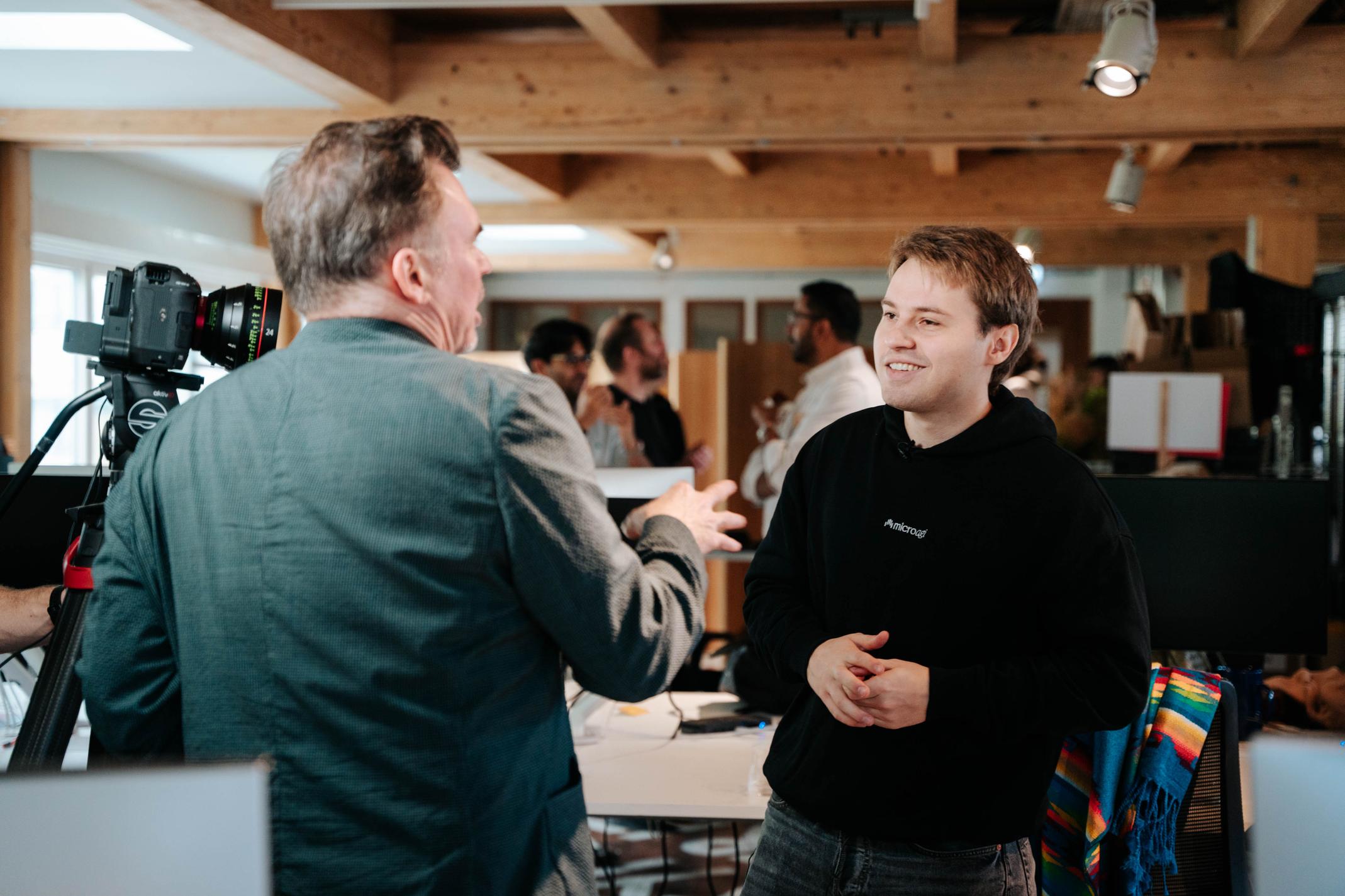 Few can claim to match a faster clock speed than microagi, the data and deployment platform for robotics. In October, they announced they had passed $100M in annualised run rate, just six months since their public launch. Faster than the likes of Lovable (8 months) and ElevenLabs (12 months).
Speaking on stage with Ziv Reichert, microagi’s CPO and co-founder Anton Poletaev reflected that scaling means solving two bottlenecks at once: collecting enough data and getting robots into real environments. So far they’ve shown considerable progress on the data side, collecting more than 400,000 hours of data via their Shift platform across 35,000+ environments in the last six months.
Deployment is a much harder task to scale. Even with the capable general-purpose model they’re building, physical distribution, site integration, safety and support could take years. Atlas, their deployment platform, is intended to make each successive deployment faster.
Scale is something that they’ve spent considerable time thinking about internally, too. From the five-person founding team we met in Aachen towards the end of last year, microagi now numbers over 100 people across Munich, Zurich, London, Istanbul, and New York. Unsurprisingly, this sort of alignment you get between five founders is easily lost as you quickly scale—so how have they combatted this internally?
Anton described microagi’s ‘vector’ approach, where a central ‘macrovector’ team is designated to keep the company focused on its most pressing problems, which is then directly tied to individual roles and priorities across the organisation. He paired this with “ruthless prioritisation”, with a focus on what matters now rather than pursuing everything at once.
The long clock
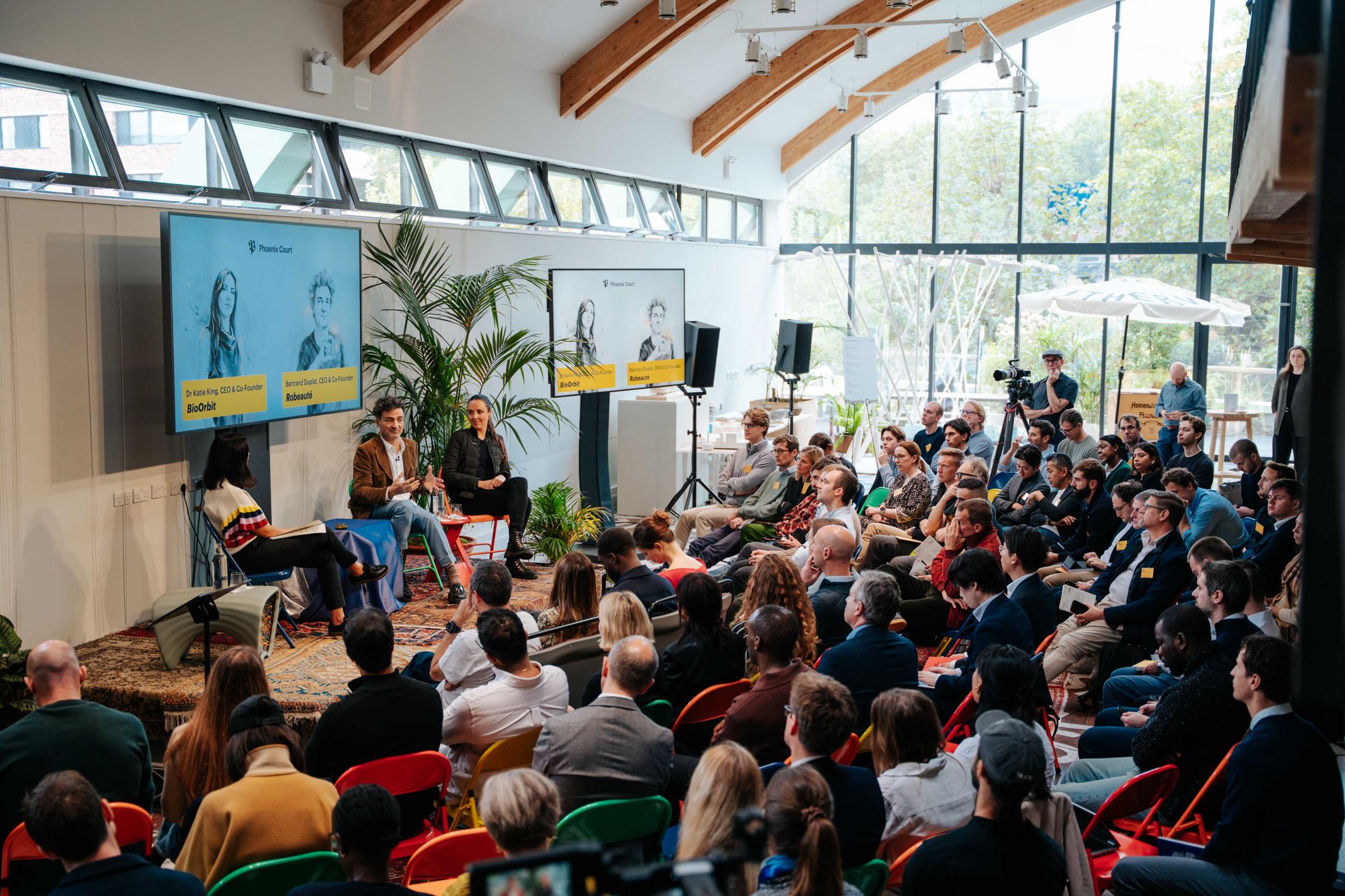 Thomas Heatherwick spends much of his time thinking about future generations. As an architect, he designs buildings that he hopes will shape cities for centuries: buildings like Google's Platform 37 and The Vessel in New York. And as the co-founder of Early, an at-home urine testing device, he is meticulously designing a product that could transform our healthcare system.
Speaking at the Showcase, Thomas reflected on the origins of Early. At an event some years ago, he was spontaneously asked, what is your dream building to design? “A hospital,” he replied almost instantly. He expands, explaining that hospitals are poorly designed, and are a literal symbol of his long-standing belief that poor design carries a human cost.
With Early, he’s designed hospitals that can fit inside your bathroom. They’ve condensed laboratories and screening rooms into a machine the same size and cost as an electric toothbrush, which can screen for biomarkers for a range of chronic conditions.
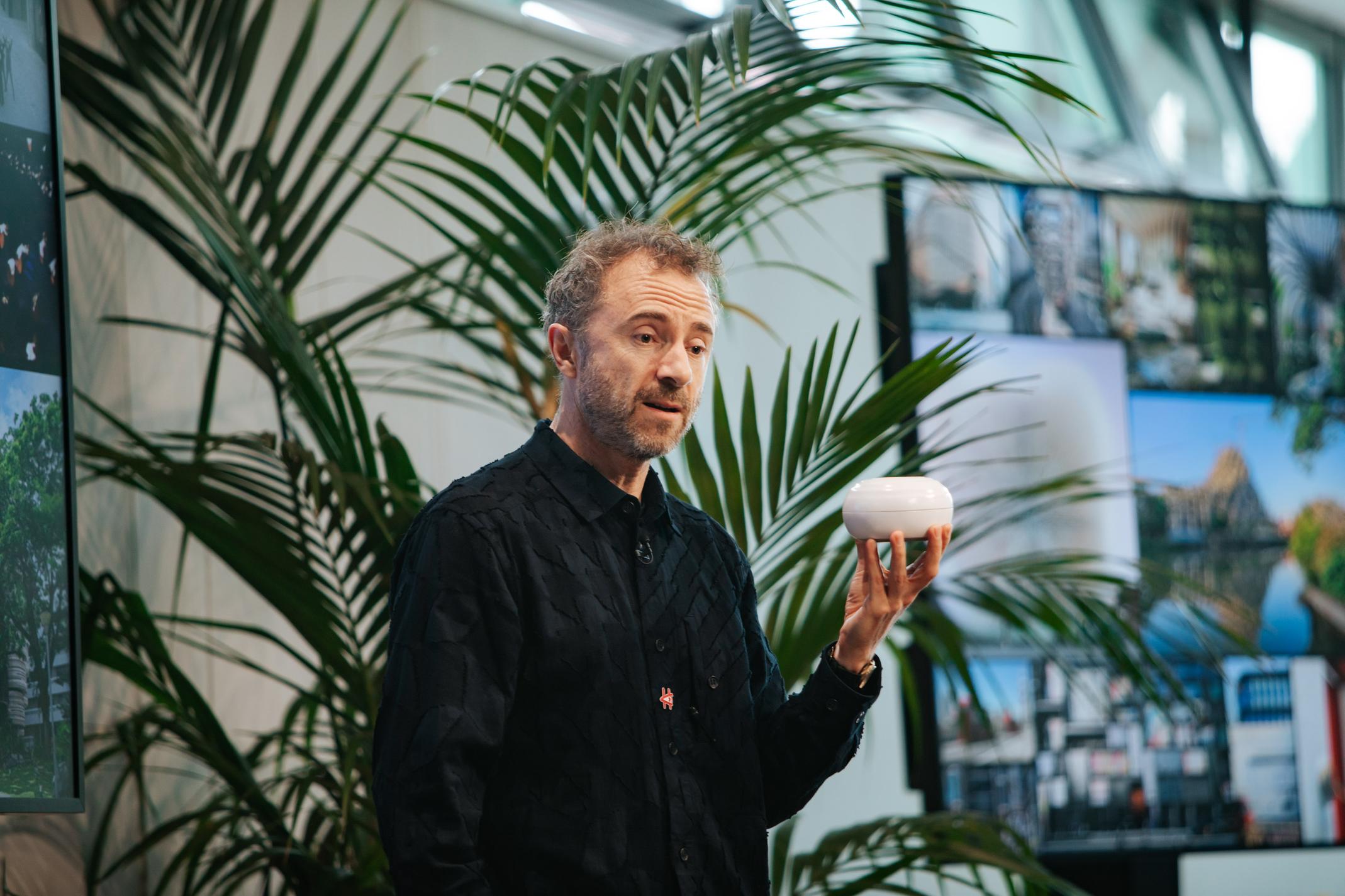
From ensuite bathrooms to outer space, BioOrbit co-founder Katie King is equally expectant of seeing her ambitions unfold in decades, not years. She’s operating in two industries that stretch back decades—space and pharmaceuticals—but have experienced interesting inflections in recent years. Space, through the diminishing cost of launch and reentry; pharmaceuticals, through rising demand for at-home medication.
Speaking at the Showcase, she reflected on how people’s perception of space has changed, and finds parallels in her own mission. “When we first thought that we’re going to put humans on the moon, we thought that’s impossible. And then we went and did it.”
Their mission is to create the infrastructure for in-space manufacturing to create a new class of medication, focused primarily on cancer treatment. She’s always had to balance thinking about the present and the future, balancing immediate priorities with long term goals that may take years.
This past year, the company has made exceptional strides, launching their prototype Baby Box-E to the International Space Station in May, which has led to the commercial momentum they’re currently seeing. Scaled production and clinical trials are around five years out, depending on regulatory approval; building and launching their own space station is more like 10 to 15 years.
If space feels remote and inaccessible, then consider the maze that is the human brain. This is the core of the problem that Bertrand Duplat is trying to solve, who joined Katie on stage at the Showcase. Despite decades of progress in neuroscience, treating severe brain conditions remains difficult for two major reasons. Firstly, straight and rigid surgical tools mean surgeons have to drill holes or risk damaging brain tissue, leading to certain areas becoming ‘inoperable’. Secondly, the blood-brain barrier makes it extremely difficult to deliver drugs to the brain.
In Robeauté, he and his co-founder Joana are designing microrobots, roughly the size of a grain of rice, to safely navigate the brain to deliver therapies and collect data. Like Katie, Bertrand leans heavily on his scientific background as a founder, to find unending sources of energy and perseverance. Even the testing cycles are similar. He explains: “A really clean failure, when the experiment is really well done and it shows that it’s not working, is almost like a success.”
Long clock companies like BioOrbit and Robeauté start with a distant vision and work backwards, with a clear roadmap for how to get there. This applies to hiring, where you not only need to consider who are the best people to help you reach your goal, you also need to understand which stage you need to bring them in at. For Bertrand, the first five years were dedicated to core research and prototyping, which required robotics expertise; now, in the regulatory and manufacturing stages, they’re hiring medtech veterans. Further down the line, pharmaceutical and biotech expertise will be critical for starting to commercialise.
Staying motivated in the short term involves coming back to that distant vision. “You have to act now to change your future, even if we won’t see the fruits for a few years,” Katie said.
Early is a state of mind
 For these five businesses, ‘early’ has vastly different meanings.
For microagi, the team is quite literally early in the journey. Founded less than a year ago, the team is at the very start of taking on a huge market and building the infrastructure to do that. Early traction shows evidence that they are doing it well, but they still have a long way to go.
For Robeauté, in the context of a business that still has a decade until it becomes a commercial reality, they are still early. But for an industry that has been around centuries, for Bertrand’s decades-long career in robotics, and for a business that’s been around nearly ten years, ‘early’ takes on a different meaning.
The same goes for BioOrbit, who still seek clinical proof for a solution that could transform the healthcare industry. Katie’s own journey, across academia, space, and pharmaceuticals, is years in the making.
For Early, the word is in their very DNA—as they say, “sometimes it’s better to be early”. Preventative healthcare is nothing new, but demonstrates an appetite for care to move from passive to active. As they build their waitlist ahead of next year’s launch, Early’s role in detecting and preventing disease is starting to take shape. And for Thomas, through a career dedicated to making technology and design human, he still feels like some of his best work is yet to come.
For Tide, it may feel like a stretch of the imagination to call a near-$500M revenue business ‘early’. They’ve spent their first decade focused on consolidating in the UK, then India, and now they’re expanding across Europe. With so much opportunity yet to capture, $500M perhaps is only the beginning. The way our own conviction has grown reflects this, first investing in Tide at seed in 2016, and continuing to invest at almost every opportunity since through LocalGlobe, Latitude, and Solar.
Concepts like speed, time, and earlyness will shift for each of these businesses across their lifetime. The clock speeds will shift, as ideas that at one point feel like a remote possibility will quickly become the mainstream, while other ideas that dominate the market could fade into the background, patiently churning out revenue.
Each of these businesses is proving exceptional by balancing the near-term, day-to-day priorities, and longer term ambition to build something that lasts for generations. They’re taking on something hard and important, and doing it the same way, by making something, testing it, and making it again. And they’ve all got their eyes on the future and on the opportunities left to capture, regardless of how much time they’ve spent building it already.
For great businesses and founders like these, early is a state of mind.
Related reading
2 Oct 2026 — editorialWritten by Phoenix Court
$5.5BN+ raised. Reflections from one of our biggest quarters to date
From robotics to cutting edge biocomputing, from outer space to inner creativity: Q3 2026 was our busiest summer in memory.
23 Sept 2026
British Business Bank commits £50m to Phoenix Court as NatWest joins M&G and HSBC to back platform investing in Britain's scale-ups
Institutional investors join forces to ensure more of the value created by UK innovation benefits Britain Meaningful multi-year partnership across Phoenix Court’s platform, supporting British technology companies across…
22 Sept 2026Written by Saul Klein
Why Britain needs to back Britain
As a serial entrepreneur, operator and investor I’ve noticed that Britain has a habit of talking itself down, even when the evidence tells a different story. Across the…

18 Aug 2026
The New Palo Alto Guidebook: Paris
The New Palo Alto Guidebook takes a trip through the neighbourhoods, cities, and regions that make up Europe’s powerful technology ecosystem. This month, we visit Paris. When Dealroom…